Archive for the ‘Uncategorized’ Category

Radio Controlled Clocks – Atomic Clocks on Shortwave

Saturday, December 26th, 2009

Atomic clocks are a marvel compared to other forms of timekeepers. It would take over 100,000 years for an atomic clock to lose a second in time which is staggering especially when you compare it to digital and mechanical clocks that can drift that much in a day.

But atomic clocks are not practical pieces of equipment to have around the office or home. They are bulky, expensive and require laboratory conditions to operate effectively. But making use of an atomic clock is straightforward enough especially as atomic time keepers like NIST (National Institute of Standards and Time) and NPL (National Physical Laboratory) broadcast the time as told by their atomic clocks on short wave radio.

NIST transmits its signal, known as WWVB from Boulder, Colorado and it is broadcast on an extremely low frequency (60,000 Hz). The radio waves from WWVB station can cover all of the continental United States plus much of Canada and Central America.

The NPL signal is broadcast in Cumbria in the UK and it is transmitted along similar frequencies. This signal, known as MSF is available throughout most of the UK and similar systems are available in other countries such as Germany, Japan and Switzerland.

Radio controlled atomic clocks receive these long wave signals and correct themselves according to any drift the clock detects. Computer networks also take advantage of these atomic clocks signals and use the protocol NTP (Network Time Protocol) and dedicated NTP time servers to synchronise hundreds and thousands of different computers.

Networking Secrets – Synchronization

Tuesday, October 20th, 2009

An efficient and error free operation is the goal of any administrator that is setting up a computer network. Ensuring the smooth running and passing of data without errors or loss of connections is a prerequisite for any decent functioning network system.

There are some fundamental things that can be carried out to minimise risk of encountering problems further down the line. A decent network server is a must, as is an efficient router but there is one piece of technology often overlooked in computer networking – the network time server.

The importance of correct computer network time only becomes apparent when something goes wrong. When an error does occur (and without adequate time synchronization it is a matter of when not if) it can be next to impossible to pin down what caused in and where. Just imagine all the error logs on the different machines all with timestamps telling a different time, finding out where and when the error occurred can be near impossible – and that’s before you can even get round to fixing it.

Fortunately most network administrators appreciate the value of synchronization and most ensure the network receives a time signal from across the Internet. However, many administrators are unaware of the vulnerabilities this may cause throughout the network.

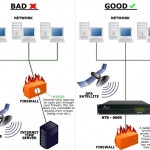
By using an online time server, a UDP port (123) needs be kept open which can be an open gate to malicious programs and users. Furthermore, there is no authentication of the online time server so the signal could be hijacked or just be inaccurate.

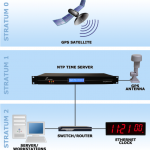
A dedicated network time server running the protocol NTP (Network Time Protocol) will operate externally to the network and receive the time from an atomic clock source directly (through radio or GPS) making NTP servers, secure, accurate and reliable.

Synchronising Computer Networks to an Atomic Clock

Wednesday, April 1st, 2009

Atomic clocks are well-known for being accurate. Most people may never have seen one but are probably aware that atomic clocks keep highly precise time. In fact modern atomic clock will keep accurate time and not lose a second in one hundred million years.

This amount of precision may seem overkill but a multitude of modern technologies rely on atomic clocks and require such a high level of precision. A perfect example is the satellite navigation systems now found in most auto cars. GPS is reliant on atomic clocks because the satellite signals used in triangulation travel at the speed of light which in a single second can cover nearly 100,000 km.

So it can be seen how some modern technologies rely on this ultra precise timekeeping from atomic clocks but their use doesn’t stop there. Atomic clocks govern the world’s global timescale UTC (Coordinated Universal Time) and they can also be used to synchronise computer networks too.

It may seem extreme to use this nanosecond precision to synchronise computer networks too but as many time sensitive transactions are conducted across the internet with such trades as the stock exchange where prices can fall or rise each and every second it can be seen why atomic clocks are used.

To receive the time from an atomic clock a dedicated NTP server is the most secure and accurate method. These devices receive a time signal broadcast by either atomic clocks from national physics laboratories or direct from the atomic clocks onboard GPS satellites.

By using a dedicated NTP server a computer network will be more secure and as it is synchronised to UTC (the global timescale) it will in effect be synchronised with every other computer network using a NTP server.

The Body Clock – Nature’s Own NTP Server

Wednesday, March 18th, 2009

Developing new methods of telling the time accurately and precisely has developed to a new obsession amongst chronologists in the twenty first century. Since the development of the first atomic clocks in the 1950’s with millisecond accuracy the race was started with organisation such as the US’s NIST (National Institute for Standards and Time) and the UK’s NPL (National Physical Laboratory) developing increasingly accurate atomic clocks.

Atomic clocks are used as the time source for high technologies and applications such as satellite navigation and air traffic control, they are also the source for time signals used by NTP servers to synchronise computer networks.

An NTP server works by continually adjusting the computers system clock to ensure it matches the time relayed by the atomic clock. In doing this the NTP server can keep a computer network to within a few milliseconds of atomic clock controlled UTC (Coordinated Universal Time).

However, as remarkable this technology may seem it appears Mother Nature has already been doing the very same thing with our own body clocks.

The human body clock is only just being understood by medical science (the study of which is called Chronobiology) but what is known is that the body clock extremely important in the functioning of our day to day lives; it is also highly accurate and works in a very similar way to the NTP server.

Whilst a NTP time server receives a time signal from an atomic clock and adjust the system clocks on computers to match, our body clocks do the very same thing. The body clock runs in a circadian rhythm in other words a 24 hour clock. When the sun rises in the morning part of the brain that governs the body clock called the suprachiasmatic nucleus - which is located in the brain’s hypothalamus, automatically corrects for the sun’s movement.

In this way the human body clock adjusts for the darker winters and lighter months of the summer which is why you may find it more difficult to wake in the winter. The body clock adjusts itself every day to ensure it is synchronised to the rotation of the sun just as a NTP time server synchronises a computer’s system clock to ensure it is running accurately  to its timing source – the atomic clock.

Common Network Time Synchronisation (NTP) Server Errors - Part Two

Wednesday, March 11th, 2009

Radio signal goes dead for several hours

The long wave transmissions such as MSF (NPL) or WWVB (NIST) are broadcast from large antennas that often need maintenance. This often requires a shut down of the broadcast while it is being done. These outages are normally posted with at least three months notice on the websites of the signals controllers (and can be automatically emailed if you register) to give prior notice.

These outages only tend to last a few hours leaving your computer network reliant on the electronic system clocks but it is doubtful there will be too much drift in that time (and any drift will be accounted for once the signal is back on. If these outages could be a potential problem than a simple solution is to invest in a dual system that will receive both GPS time server and radio signals ensuring a continuous time signal.

No time signal coming in despite the time server being powered up

This is most often caused by either lack of power going to the antenna or failing to connect to site the antenna where it can have a clear view of the sky. GPS antennas may have battery or power connections so it is always worth checking before switching the device on. Ensuring the antenna can ‘view’ the satellites when using GPS time servers is also important, remembering that windows and skylights may prevent signals getting through.

When using radio time reference such as MSF, DCF or WWVB the NTP server antennas can receive the long wave signal indoors but they are vulnerable to topography and local interference. If there is no signal or only a weak signal then try moving the antenna around until the signal strength increases enough.

Often users of these time and frequency signals find that the signal is weak throughout the day but is boosted at night. This is because the signals are ground state but have a residual skywave which can bounce of the ionosphere during the coolness of the night (ionospheric propagation).

Some users of these signals may find that despite being well within range the local topography can prevent a strong enough signal from getting through.

Common Network Time Synchronisation (NTP) Server Errors - Part One

Monday, March 9th, 2009

NTP servers are the easiest, most accurate and secure method of receiving a UTC time source (Coordinated Universal Time). Most dedicated NTP time servers will run in the background automatically synchronising the devices on a network completely automatically.

However, there are some common problems that occasionally occur in using a network time server but fortunately most can be solved relatively easily.

Losing A GPS time signal

GPS is one of the most efficient sources of UTC time. The GPS signal is available literally anywhere on the planet where there is a clear view of the sky. At any one time there are at least three satellites within range of any location and unlike radio referenced transmissions there are no maintenance outages so the signal is always uninterrupted.

However, some people find that they keep losing their GPS signal when using a GPS NTP time server. Very rarely this can be caused by extra terrestrial occurrences (solar flares – not little green men), however more commonly signal loss occurs when there has been insufficient time give for the initial acquisition lock.

To ensure a continuous signal make sure you follow manufacturer’s recommendation for obtaining acquisition. This usually means leaving the GPS time server to get a good lock for at least 24 hours (so all satellites have been in view). If not enough time is given to this then it is possible the GPS time server will lose a satellite and therefore timing information.

One second delay in a radio clock compared to internet or GPS

This is a very frequent occurrence when using a radio time server using signals such as the MSF transmission broadcast by the UK’s National Physical Laboratory. This occurs normally after the insertion of a Leap Second. Leap seconds are introduced once or twice a year to compensate for the slowing of the Earth’s rotation and to keep UTC in line with the Greenwich Meridian.
While NTP will automatically account for leap seconds with signals like the MSF it can often take some time as there is no Leap Second announcement. This announcement normally allows NTP to prepare for the leap second (which normally occurs in the last second of the last day in June or December). As signals such as MSF do not announce the upcoming leap second it can take some time for it to be accounted for. In some cases it can take a few days in others minutes. A simple solution is to manually announce the leap second.

However, if this is not done, NTP will eventually discover the leap second and adjust the network clocks.

Contiued……

New USA NTP Server Information Pages

Friday, March 6th, 2009

Following frequent requests for information from our USA clients on NTP server systems, time synchronization, GPS and NIST, our new USA  blog is now active here: NTP server

With information regarding connection to the WWVB signal, advice on setting up a NTP server network and configuration guides we hope the new synchronization blog is useful for our North American clients.

The USA information pages are now an addition to our other language blogs which include Spanish - servidor de horas, French - serveur de temps, German – NTP zeitserver, Polish - serwer NTP, Russian - Сервер NTP, Italy – Server NTP.

Network Time Server – Dual Signals

Friday, March 6th, 2009

A network time server (commonly referred to as the NTP time server after the protocol used in synchronisation – Network Time Protocol) is a device that receives a single time signal and distributes it to all devices on a network.

Network time servers are preferred as a synchronisation tool rather than the much simpler internet time servers because they are far more secure. Using the internet as a basis for time information would mean using a source outside the firewall which could allow malicious users to take advantage.

Network time servers on the other hand work inside the firewall by receiving source of UTC time (Coordinated Universal Time) from either the GPS network or specialist radio transmissions broadcast from national physics laboratories.

Both of these signals are incredibly accurate and secure with both methods providing millisecond accuracy to UTC. However, there are downsides to both systems. The radio signals broadcast by nation time and frequency laboratories are susceptible to interference and locality, while the GPS signal, although available literally everywhere on the globe can occasional be lost too (often due to bad weather interfering with the line-of-sight GPS signals.

For computer networks where high levels of accuracy are imperative, dual systems are often incorporated. These network time servers receive the time signal from both the GPS network and the radio transmissions and select an average for even more accuracy.  However, the real advantage of using a dual system is that if one signal fails, for what ever the reason, the network will not have to rely on the inaccurate system clocks as the other method of receiving UTC time should still be operational.

Atomic Clocks and the GPS Time Server

Wednesday, March 4th, 2009

Atomic clocks have been around since the 1950’s when NPL (National Physical Laboratory) in the UK developed the first reliable caesium based clock. Before atomic clocks, electronic clocks were the most accurate method of keeping track of time but while an electrical clock may lose a second in every week or so, a modern atomic clock will not lose a single second in hundreds of millions of years.

Atomic clocks are not just used to keep track of time. The atomic clock is an integral part of the GPS system (Global Positioning System) as each GPS satellite has its own onboard atomic clock that generates a time signal that is picked up by GPS receivers who can calculate their position by using the precise signal from three or more satellites.

Atomic clocks need to be used as the signal s from the satellites travel at the speed of light and as light travels nearly 300,000 km each second any slight inaccuracy could put navigation out by miles.

A GPS time server is a network time server that uses the time signal from the GPS network’s satellites to synchronise the time on computer networks. A GPS time server often uses NTP (Network Time Protocol) as a method of distributing time which is why these devices are often referred to as NTP GPS time servers.

Computer networks that are synchronised using a dedicated time server are normally synchronised to UTC (Coordinated Universal Time) and while the GPS signal is not UTC, GPS time, like UTC, is based on International Atomic Time (TAI) and is easily converted by NTP.

Useful NTP server related resources

Wednesday, February 25th, 2009

NTP homepage-  The home for the NTP Project who provides support and additional development resources for the Official Reference Implementation of NTP.

NTP Project support pages

THE NTP pool – list of public servers

NPL – The National Physical Laboratory in the UK who control the MSF radio signal.

The University of Delaware and David Mills’ information page, Professor Mills is the original inventor and developer of NTP

David Mills’ list of Public NTP Time Servers a list of public NTP servers

National Institute of Standards and Technology (NIST) who operate the USA’s WWVB radio signal

Europe’s largest supplier of NTP server related products.

Galleon UK – NTP server products for the UK

NTP Time Server .com  - one of the largest time and frequency suppliers in the United States

NTP – Wikipedia article on NTP

NTP server checker – free tool to ensure time server accuracy