Archive for the ‘GPS’ Category

NTP Servers – Which Signal is Best Radio or GPS?

Tuesday, August 31st, 2010

NTP time servers (Network Time Protocol) are an essential aspect of any computer or technology network. So many applications require accurate timing information that failing to synchronize a network adequately and precisely can lead to all sorts of errors and problems – especially when communicating with other networks.

Accuracy, when it comes to time synchronization, means only one thing – atomic clocks. No other method of keeping time is as accurate or reliable as an atomic clock. In comparison to an electronic clock, such as a digital watch, which will lose up to a second a day – an atomic clock will remain accurate to a second over 100,000 years.

Atomic clocks are not something that can be housed in an average server room though; atomic clocks are very expensive, fragile and require full time technicians to control so are usually only found in large scale physics laboratories such as the ones run by NIST (National Institute of Standards and Time – USA) and NPL (National Physical Laboratory – UK).

Getting a source of accurate time from an atomic clock is relatively easy. For a secure and reliable source of atomic clock time there are only two options (the internet can neither be described as secure nor reliable as a source of time):

  • GPS time
  • UTC time broadcast on long-wave

GPS time, from the USA’s Global Positioning System, is a time stamp generated onboard the atomic clocks on the satellites. There is one distinct advantage about using GPS as a source of time: it is available anywhere on the planet.

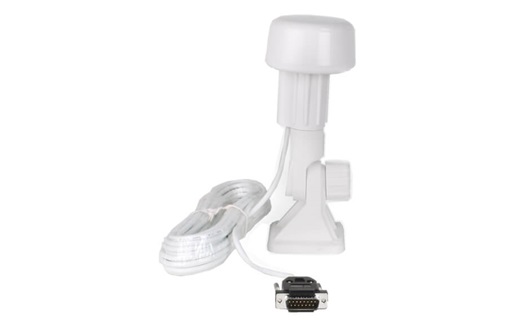
All that is required to receive and utilise GPS time is a GPS time sever and antenna; a good clear view of the sky is also needed for an assured signal. Whilst not strictly UTC time (Coordinated Universal Time) being broadcast by GPS (UTC has had 17 leap seconds added to it since the satellites were launched) the timestamp included the information needed for NTP to convert it to the universal time standard.

UTC, however, is broadcast directly from physics laboratories and is available by using a radio referenced NTP server. These signals are not available everywhere but in the USA (the signal is known as WWVB) and most of Europe (MSF and DCF) are covered. These too are highly accurate atomic clock generated time sources and as both methods come from a secure source the computer network will remain secure.

GPS Time Servers – Precise Time all the Time

Wednesday, August 11th, 2010

Keeping computer networks accurate and synchronised can’t be emphasised highly enough. Accurate time is essential in the modern global economy as computer networks across the globe are required to constantly talk to each other.

Failing to ensure a network is accurate and precise can lead to headache after headache: transactions can fail, data can get lost, and error logging and debugging can be virtually impossible.

Atomic Clocks

Atomic clocks form the basis of the global timescale – UTC (Coordinated Universal Time). UTC is used across the globe by technology and computer networks enabling the entire commercial and technological world to communicate in synchronicity together.

But as atomic clocks are highly technical (and expensive) pieces of hardware that require a team of technicians to control – where do people get a source of such accurate time?

The answer is quite simple; atomic clock timestamps are transmitted by physics laboratories and are avlaible from a whole host of sources – kept accurate by the time software NTP (Network Time Protocol).

NTP Time Servers

The most common location for sources of atomic clock generated UTC is the internet. A whole host of online time servers are avlaible for synchronisation but these can vary in their accuracy and precision. Furthermore, using a source of internet time can create vulnerabilities in the network as the firewall has to allow these timestamps through and therefore can be utilised by viruses and malicious software.

By far the most secure and accurate method of receiving a source of atomic clock generated time is to utilise the GPS network (Global Positioning System).

GPS time servers are unique in that as long as there is a clear view of the sky they can receive a source of time – anywhere on the globe, 24 hours-a-day, 365 days a year.

They are also highly accurate with a single GPS NTP time server able to synchronise entire networks to just a few milliseconds of UTC.

Competition for GPS Ever Closer

Tuesday, May 25th, 2010

Written by Richard N Williams for Galleon Systems

Since its release to the civilian population the Global Positioning System (GPS) has greatly improved and enhanced our world. From satellite navigation to the precise time used by NTP servers (Network Time Protocol) and much or our modern world’s technology.

And GPS has for several years been the only Global Navigation Satellite Systems (GNSS) and is used the world over, however, times are now changing.

There are now three other GNSS systems on the horizon that will not only act as competition for GPS but will also increase its precision and accuracy.

Glonass is a Russian GNSS system that was developed during the Cold War. However, after the fall of the Soviet Union the system fell into disrepair but it has finally been revamped and is now back up and running.

The Glonass system is now being used as a navigational aid by Russian airlines and their emergency services with in-car GNSS receivers also being rolled out for the general population to use. And the Glonass system is also allowing time synchronisation using NTP time servers as it uses the same atomic clock technology as GPS.

And Glonass is not the only competition for GPS either. The European Galileo system is on track with the first satellites expected to be launched at the end of 2010 and the Chinese Compass system is also expected to be online soon which will make four fully operational GNSS systems orbiting above Earth’s orbit.

And this is good news for those interested in ultra high time synchronisation as the systems should all be interoperable meaning anyone looking to GNSS satellites can use multiple systems to ensure even greater accuracy.

It is expected that interoperable GNSS NTP time servers will soon be available to make use of these new technologies.

European Rival to GPS takes a Further Step Forward

Wednesday, April 28th, 2010

The long awaited European rival to the USA Global Positioning System, Galileo, has taken a step forward to realisation with the delivery of the payload for first satellite.

The payload, which contains the “brains” of the Galileo satellite, includes the atomic clocks that are the basis for all global navigation satellite systems (GNSS) and provide both the positing information and the GPS time signal used by so many GPS NTP time servers for network synchronisation.

Galileo is set to not only rival the current American run GPS system, but for time synchronisation applications it is expected to operate in tandem ensuring even greater accuracy for those seeking a source of UTC time.

Galileo has undergone a lot of uncertainty since the multi-billion Euro project was first designed over a decade ago but the delivery of the first satellite’s payload to Rome, where the equipment is being finalised in preparation for launch early next year, is a real boon to the project which has often fallen into doubt.

Just like GPS, Galileo will be a fully operation navigational satellite system but will offer even greater accuracy that its aging predecessor and provide Europe with their own navigational system that isn’t owned and controlled by the US military.

As well as the positing information that will be used by motorists, pilots and other travellers, Galileo will also provide a secure and accurate source of time for the world’s computer networks and technologies to ensure synchronicity.

Currently, GPS is alone in providing this secure service, although radio transmissions in some countries provide an alternative to the GPS time server signals, although they are not as wide spread as GPS.

The first Galileo satellite is expected to reach orbit in early 2011, with the entire network planned to be operation in 2014 – although if past experiences with the project are anything to go on – you should expect at least a few delays.

Choosing a Source of Time for an NTP Synchronization

Monday, April 26th, 2010

Accurate time is essential in the modern world of internet banking, online auctions and global finance. Any computer network that is involved in global communication needs to have an accurate source of the global timescale UTC (Coordinated Universal Time) to be able to talk to other networks.

Receiving UTC is simple enough. It is available from multiple sources but some are more reliable than others:

Internet Time Sources

The internet is awash with time sources. These vary in reliability and accuracy but some trusted organisations like NIST (National Institute of Standards and Time) and Microsoft. However, there are disadvantages with internet time sources:

Reliability – The demand for internet sources of UTC often means it can be difficult to access them

Accuracy – most internet time servers are stratum 2 devices which means they rely on a source of time themselves. Often errors can occur and many sources of time can be very inaccurate.

Security – Perhaps the biggest issue with internet time sources is the risk they pose to security. To receive a time stamp from across the internet the firewall needs to have an opening to allow the signals to pass through; this can lead to malicious users taking advantage.

Radio Referenced Time Servers.

A secure method of receiving UTC time stamps is available by using a NTP time server that can receive radio signals from labs like NIST and NPL (National Physical Laboratory. Many countries have these broadcasted time signals which are highly accurate, reliable and secure.

GPS Time servers

Another source for dedicated time servers is GPS. The big advantage of a GPS NTP time server is that the time source is available everywhere on the planet with a clear view of the sky. GPS time servers are also highly accurate, reliable and just as secure as radio referenced time servers.

GPS as a Timing Reference for NTP servers

Friday, April 16th, 2010

The GPS system is familiar to most people. Many cars now have a GPS satellite navigation device in their cars but there is more to the Global Positioning System than just wayfinding.

The Global Positioning System is a constellation of over thirty satellites all spinning around the globe. The GPS satellite network has been designed so that at any point in time there is at least four satellites overhead – no matter where you are on the globe.

Onboard each GPS satellite there is a highly precise atomic clock and it is the information from this clock that is sent through the GPS transmissions which by triangulation (using the signal from multiple satellites) a satellite navigation receiver can work out your position.

But these ultra precise timing signals have another use, unbeknown to many users of GPS systems. Because the timing signals from the GPS atomic clocks are so precise, they make a good source of time for synchronising all sorts of technologies – from computer networks to traffic cameras.

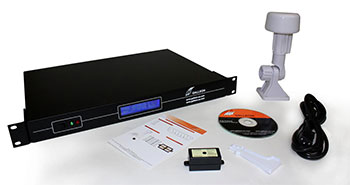
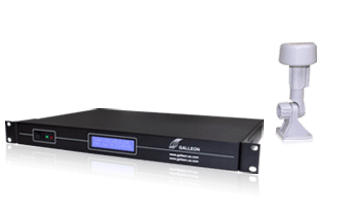
To utilise the GPS timing signals, a GPS time server is often used. These devices use NTP (Network Time Protocol) to distribute the GPS timing source to all devices on the NTP network.

NTP regularly checks the time on all the systems on its network and adjusts it accordingly if it has drifted to what the original GPS timing source is.

As GPS is available anywhere on the planet it provides a really handy source of time for many technologies and applications ensuring that whatever is synchronised to the GPS timing source will remain as accurate as possible.

A single GPS NTP server can synchronize hundreds and thousands of devices including routers, PCs and other hardware ensuring the entire network is running perfectly coordinated time.

The Effect of Solar Flares on GPS

Wednesday, February 17th, 2010

Forthcoming space weather may affect GPS devices including satellite navigation and NTP GPS time servers.

Whilst many of us have had to cope with some extreme weather last winter, further storms are on their way – this time from space.

Solar flares are a regular occurrence on the surface of the sun. Whilst scientists are not completely sure what causes them we know two things about solar flares: – they are cyclical – and are related to sunspot activity.

For that last eleven years the sun’s sunspot activity – small dark depressions that appear on the surface of the sun – has been very minimal. But this eleven year cycle has come to an end and there has been a rise in sun spots at the end of last year meaning 2010 will be a bumper year for both sunspots and solar flares.

But there is no need to worry about becoming toasted by solar flares as these bursts of hot gases that flare from the sun never get far enough to reach the Earth, however, they can effect us in different ways.

Solar flares are bursts of energy and as such emit radiation and high energy particles. On earth, we are protected by these blasts of energy and radiation by the earth’s magnetic field and ionosphere, however, satellite communications are not and this can lead to trouble.

Whilst the effect of solar flare radiation is very weak, it can slow down and reflect radio waves as they travel through the ionosphere towards Earth. This interference can cause GPS satellites in particular extreme problems as they are reliant on accuracy to provide navigational information.

While the effects of solar flares are mild, it is possible GPS devices will encounter brief periods of no signal and also the problem of inaccurate signals meaning positing information may become unreliable.

This will not just affect navigation either as the GPS system is used by hundreds and thousands of computer networks as a source of reliable time.

Whilst most dedicated GPS time servers should be able to cope with periods of instability without losing precision, for worried network administrators not wanting to go into work to find their systems have crashed because of a lack of synchronisation may want to consider using a radio referenced Network time server that uses broadcast transmission such as MSF or WVBB.

Dual NTP time servers (Network Time Protocol) are also available that can receive both radio and GPS, ensuring a source of time is always constantly available.

Choosing a Time Server for your Network

Monday, February 1st, 2010

Any network administrator will tell you how important time synchronization is for a modern computer network. Computers rely on the time for nearly everything, especially in today’s age of online trading and global communication where accuracy is essential.

Failing to ensure that computers are accurately synced together could lead to all manner of problems: data loss, security vulnerabilities, unable to conduct time sensitive transactions and difficulties debugging can all be caused by a lack of, or not adequate enough, time synchronization.

But ensuring every computer on a network has the exact same time is simple thanks to two technologies: the atomic clock and the NTP server (Network Time Protocol).

Atomic clocks are extremely accurate chronometers. They can keep time and not drift by as much of a second in thousands of years and it is this accuracy that has made possible technologies and applications such as satellite navigation, online trading and GPS.

Time synchronization for computer networks is controlled by the network time server, commonly referred to as the NTP server after the time synchronization protocol they use, Network Time Protocol.
When it comes to choosing a time server, there are really only two real type – the radio reference NTP time server and the GPS NTP time server.

Radio reference time servers receive the time from long wave transmission broadcast by physics laboratories like NIST in North America or NPL in the UK. These transmissions can often be picked up throughout the country of origin (and beyond) although local topography and interference from other electrical devices can interfere with the signal.

GPS time servers, on the other hand, use the satellite navigation signal transmitted from GPS satellites. The GPS transmissions are generated by atomic clocks onboard the satellites so they are a highly accurate source of time just like the atomic clock generated time broadcast by the physics laboratories.

Apart from the disadvantage of having to have a roof top antenna (GPS works by line of sight so a clear view of the sky is essential), GPS is obtainable literally everywhere on the planet.

As both types of time server can provide an accurate source of reliable time the decision of which type of time server should be based on the availability of long wave signals or whether it is possible to install a rooftop GPS antenna.

Atomic Clock to be attached to International Space Station

Wednesday, December 16th, 2009

One of the world’s most accurate atomic clocks is to be launched into orbit and attached to the International Space Station (ISS) thanks to an agreement signed by the French space agency.

The PHARAO (Projet d’Horloge Atomique par Refroidissement d’Atomes en Orbite) atomic clock is to attached to the ISS in an effort to more accurately test Einstein’s theory of relatively as well as increasing the accuracy of Coordinated Universal Time (UTC) amongst other geodesy experiments.

PHARAO is a next generation caesium atomic clock with an accuracy that corresponds to less than a second’s drift every 300,000 years. PHARAO is to be launched by the European Space Agency (ESA) in 2013.

Atomic clocks are the most accurate timekeeping devices available to mankind yet they are susceptible to changes in gravitational pull, as predicted by Einstein’s theory, as time itself is slewed by the Earth’s pull. By placing this accurate atomic clock into orbit the effect of Earth’s gravity is lessened allowing PHARAO to be more accurate than Earth based clock.

While atomic clocks are not new to orbit, as many satellites; including the GPS network (Global Positioning System) contain atomic clocks, however, PHARAO will be among the most accurate clocks ever launched into space, allowing it to be used for far more detailed analysis.

Atomic clocks have been around since the 1960’s but their increasing development has paved the way for more and more advanced technologies. Atomic clocks form the basis of many modern technologies from satellite navigation to allowing computer networks to communicate effectively across the globe.

Computer networks receive time signals from atomic clocks via NTP time servers (Network Time Protocol) which can accurately synchronise a computer network to within a few milliseconds of UTC.

How Satellite Navigation Works

Monday, November 23rd, 2009

Satellite navigational systems, or sat navs, have changed the way we navigate our way around the high roads. Gone are the days when travellers had to have a glove box full of maps and gone too is the need to stop and ask a local for directions.

Satellite navigation means that we an now go from point A to point B confident our systems will take us there and while sat nav systems are not fool proof (we must have all read the stories of people driving over cliffs and into rivers etc), it has certainly revolutionised our wayfinding.

Currently there is only one Global Navigational Satellite System (GNSS) the American run Global Positioning System (GPS). Although, a rival European System (Galileo) is set to go online sometime after 2012 and a both a Russian (GLONASS) and Chinese (COMPASS) system are being developed.

However, all these GNSS networks will operate using the same technology as employed by GPS, and in fact, current GPS systems should be able to utilise these future systems without much alteration.

The GPS system is basically a constellation of satellites (currently there are 27). These satellites each contain onboard an atomic clock (actually two are on most GPS satellites but for the purpose of this explanation only one need be considered). The signals that are transmitted from the GPS satellite contain several pieces of information sent as one integer:

* The time the message was sent

* The orbital position of the satellite (known as the ephemeris)

* The general system health and orbits of the other GPS satellites (known as the almanac)

A satellite navigation receiver, the kind found on the dashbopard of your car, receives this information and using the timing information works out the exact distance from the receiver to the satellite. By using three or more of these signals the exact position can be triangulated (four signals are actually required as height above sea level has to be worked out too).

Because the triangulation works out when the time signal was sent and how long it took to arrive at the receiver, the signals have to be incredibly accurate. Even a second of inaccuracy could see the navigational information out but thousands of kilometres as light, and therefore radio signals, can travel nearly 300,000 km each second.

Currently the GPS satellite network can provide navigational accuracy to within 5 metres which goes to show just how accurate atomic clocks can be.