Additional Leap Second in June: Will it Cause Problems?
| By Daniel Waldron
The Paris Observatory has announced an additional leap second will be added to clocks in June 2015. What does this mean for businesses? Galleon Systems examines.

| By Daniel Waldron
The Paris Observatory has announced an additional leap second will be added to clocks in June 2015. What does this mean for businesses? Galleon Systems examines.
| By Daniel Waldron
Accurate time specialists, Galleon Systems, assess the implications of NIST’s new atomic clock.
NIST (National Institute of Standards and Technology) has revealed a new atomic clock, claiming that it has the capability to maintain accurate time for the next 300 million years.
| By Richard N Williams
There are various solutions for synchronised office clocks, suitable for use in offices of all sizes, even those spread out across the country. The simplest solution is to use atomic clock radio receiver clocks. These come with either digital or analogue displays and they use radio transmissions to receive a source of atomic clock time (UTC – Coordinated Universal Time).
| By Richard N Williams
As British summer time officially ended last weekend, with the clocks going back to bring the UK back to GMT (Greenwich Mean Time), the debate about the annual clock changing has started again. The Coalition Government has proposed plans to change the way Britain keeps time by shifting the clocks forward another hour, and in effect reverting to Central European Time (ECT)..
 ECT, would mean that Britain would remain an hour ahead of GMT in the winter and two hours ahead in the summer, providing lighter evenings but darker mornings, especially for those north of the border.
However, any proposed plans have stiff opposition from the Scottish Government who suggest that by altering the clocks, many areas in Scotland wouldn’t see daylight during winter until about 10am, meaning many children would have to go to school in the dark.
Other opponents, include traditionalists, argue that GMT has been the basis for British time for over a century, and that any change would be simply … unBritish.
However, a change to ECT would make things easier for businesses that trade with Europe, keeping British workers on a similar timescale to their European neighbours.
Whatever the outcome of the proposed changes to GMT, little will change when it comes to technology and computer networks as they already keep the same timescale all over the globe: UTC (Coordinated Universal Time).
UTC is a global timescale kept true by an array of atomic clocks and is used by all sorts of technologies such as computer networks, CCTV cameras, bank telling machines, air traffic control systems and stock exchanges.
Based on GMT, UTC remains the same the world over, enabling global communication and the transfer of data across time zones without error. The reason for UTC is obvious when you consider the amount of trade that goes on across borders. With industries such as the stock exchange, where stocks and shares fluctuate in price continuously, split second accuracy is essential for global traders. The same is true for computer networks, as computers use time as the only reference as to when an event has taken place. Without adequate synchronisation, a computer network may lose data and international transactions would become impossible.
Most technologies keep synchronised to UTC by using NTP time servers (Network Time Protocol), which continually check system clocks across whole networks to ensure that they all are synced to UTC.
NTP time servers receive atomic clock signals, either by GPS (Global Positioning Systems) or by radio signal broadcast by national physics laboratories such as NIST in the United States or NPL in the UK. These signals provide millisecond accuracy for technologies, so no matter what time zone a computer network is, and no matter where it is in the world, it can have the same time as every other computer network across the globe that it has to communicate with.
| By Richard N Williams
Time synchronisation is something easily taken for granted in this day and age. With GPS NTP servers, satellites beam down time to technologies, which keeps them synced to the world’s time standard UTC (Coordinated Universal Time).
Before UTC, before atomic clocks, before GPS, keeping time synchronised was not so easy. Throughout history, humans have always kept track of time, but accuracy was never that important. A few minutes or an hour or so difference, made little difference to people’s lives throughout the medieval and regency periods; however, come the industrial revolution and the development of railways, factories and international commerce, accurate timekeeping became crucial.
Greenwich Mean Time (GMT) became time standard in 1880, taking over from the world’s first time standard railway time, developed to ensure accuracy with railway timetables. Soon, all businesses, shops and offices wanted to keep their clocks accurate to GMT, but in an age before electrical clocks and telephones, this proved difficult.
Enter the Greenwich Time Lady. Ruth Belville was a businesswoman from Greenwich, who followed in her father’s footsteps in delivering time to businesses throughout London. The Belville’s owned a highly accurate and expensive pocket watch, a John Arnold chronometer originally made for the Duke of Sussex.
Every week, Ruth, and her father before her, would take the train to Greenwich where they would synchronise the pocket watch to Greenwich Mean Time. The Belvilles would then travel around London, charging businesses to adjust their clocks their chronometer, a business enterprise that lasted from 1836 to 1940 when Ruth finally retired at the age of 86.
BY this time, electronic clocks had began to take over traditional mechanical devices and were more accurate, needing less synchronisation, and with the telephone speaking clock introduced by the General Post Office (GPO) in 1936, timekeeping services like the Belville’s became obsolete.
Today, time synchronisation is far more accurate. Network time servers, often using the computer protocol NTP (Network Time Protocol), keep computer networks and modern technologies true. NTP time servers receive an accurate atomic clock time signal, often by GPS, and distribute the time around the network. Thanks to atomic clocks, NTP time servers and the universal timescale UTC, modern computers can keep time to within a few milliseconds of each other.
| By Richard N Williams
The physics world got itself into a bit of a tizz this month as scientists at CERN, the European Laboratory for Particle Physics, found an anomaly on one of their experiments, which seemed to show that some particles were travelling faster than light.
Faster than light travel for any particle is prohibited of course, according to Einstein’s Special Theory of Relativity, but the OPERA team at CERN, who fired neutrinos around a particle accelerator, travelling for 730 km, found that the neutrinos travelled the distance 20 parts per million faster than photons (light particles) meaning they broke Einstein’s speed limit.
While this experiment could prove to be one of the most important discoveries in physics, physicists are remaining sceptical, suggesting that a cause could be an error generated in the difficulties and complexities of measuring such high speeds and distances.
The team at CERN used GPS time servers, portable atomic clocks and GPS positioning systems to make their calculations, which all provided accuracy in distance to within 20cm and an accuracy of time to within 10 nanoseconds. However, the facility is underground and the GPS signals and other data streams had to be cabled down to the experiment, a latency the team are confident they took into account during their calculations.
Physicists from other organisations are now attempting to repeat the experiments to see if they get the same results. Whatever the outcome, this type of groundbreaking research is only possible thanks to the accuracy of atomic clocks that are able to measure time to millionths of a second.
To synchronise a computer network to an atomic clock you don’t need to have access to a physics laboratory like CERN as simple NTP time servers like Galleons NTS 6001 will receive an accurate source of atomic clock time and keep all hardware on a network to within a few milliseconds of it.
| By Stuart
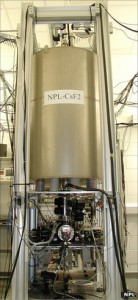
Most people will have heard of atomic clocks, most people, probably without realising have even used them; however, I doubt many people reading this will have ever seen one. Atomic clocks are highly technical and complicated pieces of machinery. Relying on vacuums, super-coolants such as liquid nitrogen and even lasers, most atomic clocks are only found in laboratories such as NIST (National Institute for Standards and Time) in the US, or NPL (National Physical Laboratory) in the UK.
No other form of timekeeping is as accurate as an atomic clock. Atomic clocks form the basis of world’s global timescale UTC (Coordinated Universal Time). Even the length Earth’s spin requires manipulation by the addition of leap seconds to UTC to keep the day synchronised.
Atomic clocks work by using the oscillating changes of atoms during different energy states. Caesium is the preferred atom used in atomic clocks, which oscillates 9,192,631,770 times a second. This is a constant effect too, so much so that a second is now defined by this many oscillations of the caesium atom.
Louis Essen built the first accurate atomic clock in 1955 at the National Physical Laboratory in the UK, since then atomic clocks have become increasingly more accurate with modern atomic clocks able to maintain time for over a million years without ever losing a second.
In 1961, UTC became the world’s global timescale, and by 1967, the International System of Units adopted the Caesium frequency as the official second.
Since then, atomic clocks have become part of modern technology. Onboard every GPS satellite, atomic clocks beam time signals to Earth, enabling satellite navigation systems in car, boats and aeroplanes to judge their locations precisely.
UTC time is also essential for trade in the modern world. With computer networks speaking to each other across timezones, using atomic clocks as a reference prevents errors, ensures security and provides reliable data transfer.
Receiving a signal from an atomic clock for computer time synchronisation is incredibly easy. NTP time servers that receive the time signal from GPS satellites, or those broadcast on radio waves from places NPL and NIST, enable computer networks across the globe to keep secure and accurate time.
| By Richard N Williams
Most of us think we know what the time it is. At a glance of our wristwatches or wall clocks, we can tell what time it is. We also think we have a pretty good idea of the speed time move forwards, a second, a minute, an hour or a day are pretty well-defined; however, these units of time are completely man-made and are not as constant as we may think.
Time is an abstract concept, while we may think it is the same for everybody, time is affected by its interaction with the universe. Gravity, for instance, as Einstein observed, has the ability to warp space-time altering the speed in which time passes, and while we all live on the same planet, under the same gravitational forces, there are subtle differences in the speed in which time passes.
Using atomic clocks, scientists are able to establish the effect Earth’s gravity has on time. The high above sea level an atomic clock is placed, the quicker time travels. While these differences are minute, these experiments clearly demonstrate that Einstein’s postulations were correct.
Atomic clocks have been used to demonstrate some of Einstein’s other theories regarding time too. In his theories of relativity, Einstein argued that speed is another factor that affects the speed at which time passes. By placing atomic clocks on orbiting spacecraft or aeroplanes travelling at speed, the time measured by these clocks differs to clocks left static on Earth, another indication that Einstein was right.
Before atomic clocks, measuring time to such degrees of accuracy was impossible, but since their invention in the 1950’s, not only have Einstein’s postulations proved right, but also we have discovered some other unusual aspects to how we regard time.
While most of us think of a day as 24-hours, with every day being the same length, atomic clocks have shown that each day varies. Furthermore, atomic clocks have also shown that the Earth’s rotation is gradually slowing down, meaning that days are getting slowly longer.
Because of these changes to time, the world’s global timescale, UTC (Coordinated Universal Time) needs occasional adjustments. Every six months or so, leap seconds are added to ensure UTC runs at the same rate as an Earth day, accounting for the gradual slowing down of the planet’s spin.
For technologies that require high levels of accuracy, these regular adjustments of time are accounted for by the time protocol NTP (Network Time Protocol) so a computer network using an NTP time server is always kept true to UTC.
| By Richard N Williams
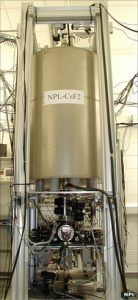 Researchers have discovered that the British atomic clock controlled by the UK’s National Physical Laboratory (NPL) is the most accurate in the world.
NPL’s CsF2 caesium fountain atomic clock is so accurate that it wouldn’t drift by a second in 138 million years, nearly twice as accurate as first thought.
Researchers have now discovered the clock is accurate to one part in 4,300,000,000,000,000 making it the most accurate atomic clock in the world.
The CsF2 clock uses the energy state of caesium atoms to keep time. With a frequency of 9,192,631,770 peaks and troughs every second, this resonance now governs the international standard for an official second.
The international standard of time—UTC—is governed by six atomic clocks, including the CsF2, two clocks in France, one in Germany and one in the USA, so this unexpected increase in accuracy means the global timescale is even more reliable than first thought.
UTC is essential for modern technologies, especially with so much global communication and trade being conducted across the internet, across borders, and across timezones.
UTC enables separate computer networks in different parts of the world to keep exactly the same time, and because of its importance accuracy and precision is essential, especially when you consider the types of transactions now conducted online, such as the buying of stocks and shares and global banking.
Receiving UTC requires the use of a time server and the protocol NTP (Network Time Protocol). Time servers receive a source of UTC direct from atomic clocks sources such as NPL, who broadcast a time signal over long wave radio, and the GPS network (GPS satellites all transmit atomic clock time signals, which is how satellite navigation systems calculate position by working out the difference in time between multiple GPS signals.)
NTP keeps all computers accurate to UTC by continuously checking each system clock and adjusting for any drift compared to the UTC time signal. By using an NTP time server, a network of computers is able to remain within a few milliseconds of UTC preventing any errors, ensuring security and providing an attestable source of accurate time.
| By Richard N Williams
Most of us recognise how long an hour, a minute, or a second is, and we are used to seeing our clocks tick past these increments, but have you ever thought what governs clocks, watches and the time on our computers to ensure that a second is a second and an hour an hour?
Early clocks had a very visible form of clock precision, the pendulum. Galileo Galilei was the first to discover the effects of weight suspended from a pivot. On observing a swinging chandelier, Galileo realised that a pendulum oscillated continuously above its equilibrium and didn’t falter in the time between swings (although the effect weakens, with the pendulum swinging less far, and eventually stops) and that a pendulum could provide a method of keeping time.
Early mechanical clocks that had pendulums fitted proved highly accurate compared to other methods tried, with a second able to be calibrated by the length of a pendulum.
Of course, minute inaccuracies in measurement and effects of temperature and humidity meant that pendulums were not wholly precise and pendulum clocks would drift by as much as half an hour a day.
The next big step in keeping track of time was the electronic clock. These devices used a crystal, commonly quartz, which when introduced to electricity, will resonate. This resonance is highly precise which made electric clocks far more accurate than their mechanical predecessors were.
True accuracy, however, wasn’t reached until the development of the atomic clock. Rather than using a mechanical form, as with a pendulum, or an electrical resonance as with quartz, atomic clocks use the resonance of atoms themselves, a resonance that doesn’t change, alter, slow or become affected by the environment.
In fact, the International System of Units that define world measurements, now define a second as the 9,192,631,770 oscillations of a caesium atom.
Because of the accuracy and precision of atomic clocks, they provide the source of time for many technologies, including computer networks. While atomic clocks only exist in laboratories and satellites, using devices like Galleon’s NTS 6001 NTP time server.
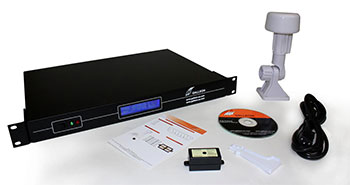
A time server such as the NTS 6001 receives a source of atomic clock time from either GPS satellites (which use them to provide our sat navs with a way to calculate position) or from radio signals broadcast by physics laboratories such as NIST (National Institute of Standards and Time) or NPL (National Physical Laboratory).















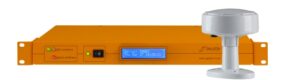
NTS-7001-GPS | An enterprise grade time server with PPS locking, designed for large networks that require high-precision time accuracy.

NTS-7002-GPS | An NTP time server with dual power inputs, mains and or battery, for enhanced network redundancy.
NTS-4000-GPS-R - A complete solution for synchronising the time across any computer network.
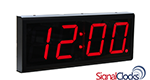
C1 44-R-M-NTP - PoE digital wall clock
NTS-6001-GPS